Minecraft Biomes: Every Biome in Java 26.3 and Bedrock 26.50
Minecraft biomes explained: all 66 in Java 26.3, how to find any of them, which are rarest, and what's new. Updated 7 October 2026.

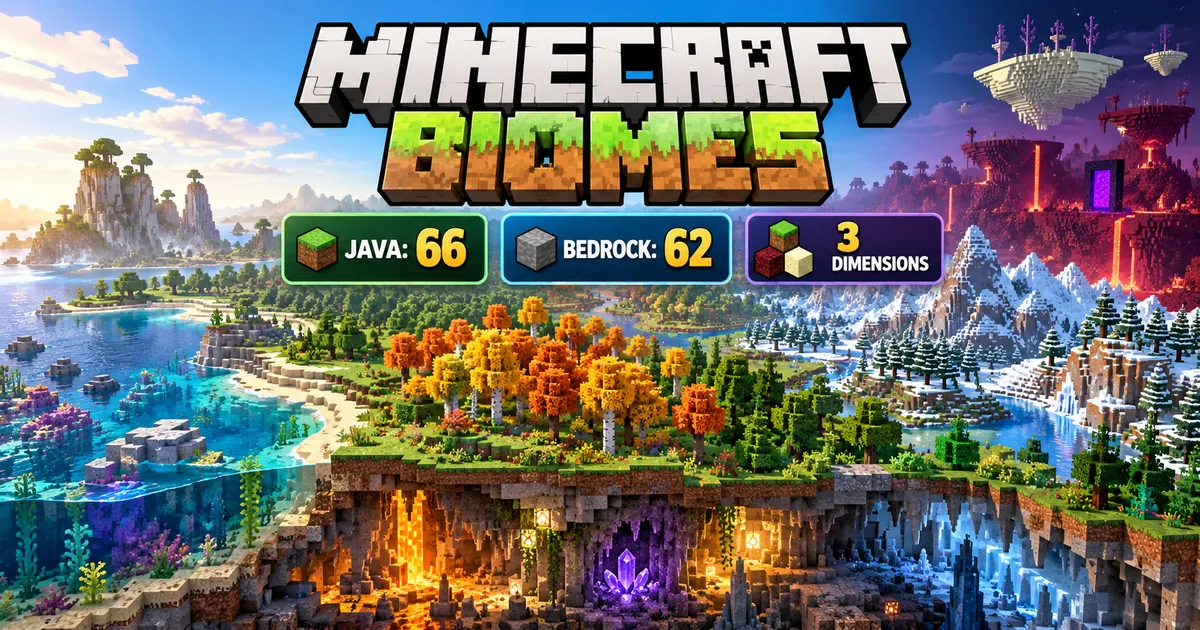
Minecraft biomes are the regions that set a world’s terrain, climate, plants and mob spawns. On Java Edition 26.3, our tally is 66 biomes: 56 in the Overworld, 5 in the Nether and 5 in the End.
Bedrock Edition 26.50 counts the whole End as one biome, so it totals 62.
The newest additions are Sulfur Caves (June 2026) and Dappled Forest (September 2026). Ice Caves are in Java snapshot testing for 26.4.
Applies to: Java Edition 26.3 (released 15 September 2026) and Bedrock Edition 26.50, on PC, console and mobile. Last checked 7 October 2026.
Sources: Mojang’s official patch notes for 26.2, 26.3 and 26.4 Snapshot 3, plus the Minecraft Wiki’s biome list. Mojang doesn’t publish a biome total that we could find, so 66 is our own count. We didn’t playtest this.
What is a biome in Minecraft?
A biome is a region of a Minecraft world with its own terrain, climate, plants, mobs and colours. The game assigns biomes when it generates new chunks.
Rebuilding an area to look like another biome doesn’t change it. In Java, the /fillbiome command can, according to the Minecraft Wiki.
How many biomes are in Minecraft in 2026?
Java Edition 26.3 has 66 biomes and Bedrock Edition 26.50 has 62. Both have 56 Overworld biomes and 5 Nether biomes, and only the End differs.
|
Dimension |
Java 26.3 |
Bedrock 26.50 |
|
Overworld |
56 |
56 |
|
Nether |
5 |
5 |
|
End |
5 |
1 |
|
Total |
66 |
62 |
Why does every guide give a different number?
Counts depend on the version and on what the writer includes. The Minecraft Wiki’s older tally gives 64 for Java and 90 for Bedrock, but the Java figure includes a Superflat-only biome and the Bedrock figure includes 27 unused ones.
Lists written before 26.2 stop at 54 Overworld biomes. Sulfur Caves and Dappled Forest bring that to 56. We also leave out The Void, which only appears in Java Superflat and Buffet worlds.
What are all the Minecraft biomes?
Here is every biome by dimension. The group names come from the Minecraft Wiki and aren’t official Mojang categories.
Overworld: oceans and mushroom fields (10)
|
Biome |
Known for |
|
Ocean |
Standard sea with a gravel floor, squid and fish. |
|
Deep Ocean |
Twice as deep as Ocean. Ocean monuments can generate here. |
|
Warm Ocean |
The only ocean with coral reefs and sea pickles. No deep version. |
|
Lukewarm Ocean |
Sandy floor, kelp and seagrass. |
|
Deep Lukewarm Ocean |
A deeper Lukewarm Ocean. Ocean monuments can generate here. |
|
Cold Ocean |
Dark blue water over gravel. Salmon spawn here. |
|
Deep Cold Ocean |
A deeper Cold Ocean. Ocean monuments can generate here. |
|
Frozen Ocean |
Ice patches and icebergs. Polar bears and strays spawn, dolphins do not. |
|
Deep Frozen Ocean |
Deeper, with big icebergs and blue ice. Ocean monuments can generate here. |
|
Mushroom Fields |
Mycelium islands with mooshrooms. No natural hostile spawns. |
Overworld: highlands and mountains (10)
|
Biome |
Known for |
|
Jagged Peaks |
The tallest, spikiest snowy peaks. Only goats spawn. |
|
Frozen Peaks |
Snow and packed ice on smoother summits. Only goats spawn. |
|
Stony Peaks |
Warm-region peaks of stone and calcite, with no snow. |
|
Meadow |
Flowery plateau. Lone trees carry bee nests, and villages can generate. |
|
Cherry Grove |
Pink cherry trees and falling petals. |
|
Grove |
Snowy spruce forest on lower mountain slopes, with powder snow. |
|
Snowy Slopes |
Steep powder-snow slopes. Goats spawn and igloos can generate. |
|
Windswept Hills |
Steep hills with llamas, emerald ore and infested stone. |
|
Windswept Gravelly Hills |
Hills covered in gravel, with few trees. |
|
Windswept Forest |
Windswept hills with spruce and oak cover. |
Overworld: forests and jungles (14)
|
Biome |
Known for |
|
Forest |
Oak and birch trees. A common place to start. |
|
Flower Forest |
Almost every small flower. Good for dyes. |
|
Taiga |
Spruce trees, sweet berries, wolves and foxes. |
|
Old Growth Pine Taiga |
Giant 2×2 spruce, podzol and mossy cobblestone boulders. |
|
Old Growth Spruce Taiga |
Giant spruce with leaves covering most of the trunk. |
|
Snowy Taiga |
Snow-covered spruce forest. Igloos can generate. |
|
Birch Forest |
Birch trees only. |
|
Old Growth Birch Forest |
Taller birch trees than the standard version. |
|
Dark Forest |
Dense dark oak canopy. Hostile mobs can spawn in daylight, and woodland mansions can generate. |
|
Pale Garden |
Grey pale oak forest. Home of the creaking and resin. Added in Java 1.21.4. |
|
Dappled Forest |
Poplar forest near cold biomes. Added in 26.3. |
|
Jungle |
Tall trees, parrots, ocelots and pandas, plus cocoa and melons. |
|
Sparse Jungle |
A thinner jungle with the same animals. |
|
Bamboo Jungle |
Bamboo-heavy jungle. Pandas spawn more often here. |
Overworld: wetlands and coasts (7)
|
Biome |
Known for |
|
River |
Cuts between biomes. Good for clay and fishing. |
|
Frozen River |
A river with an ice surface, found in snowy areas. |
|
Swamp |
Lily pads, slimes at night, witch huts and blue orchids. |
|
Mangrove Swamp |
Mangrove trees on mud, with warm frogs. |
|
Beach |
Sand where land meets ocean. Turtles spawn here. |
|
Snowy Beach |
Snow-covered sand. Buried treasure can generate. |
|
Stony Shore |
Stone coast where mountains meet the sea. No passive mobs spawn. |
Overworld: flatlands (4)
|
Biome |
Known for |
|
Plains |
Flat grassland with common villages and horses. |
|
Sunflower Plains |
A Plains variant and the only place sunflowers generate naturally. |
|
Snowy Plains |
Snow-covered flats with igloos, polar bears and strays. |
|
Ice Spikes |
A rare snowy variant with tall packed-ice spikes. |
Overworld: arid biomes (7)
|
Biome |
Known for |
|
Desert |
Sand, cacti and husks. Desert temples, wells and villages generate here. |
|
Savanna |
Acacia trees and dry grass. Villages and armadillos. |
|
Savanna Plateau |
A raised savanna. No villages or outposts. |
|
Windswept Savanna |
Steep, chaotic terrain with waterfalls and lavafalls. |
|
Badlands |
Terracotta, red sand and extra gold ore. |
|
Wooded Badlands |
Badlands plateaus topped with oak forest. |
|
Eroded Badlands |
Rare badlands with tall terracotta spires. |
Overworld: cave biomes (4)
|
Biome |
Known for |
|
Lush Caves |
Moss, glow berries and dripleaf. The only place axolotls spawn. |
|
Dripstone Caves |
Pointed dripstone and large copper ore deposits. |
|
Deep Dark |
Sculk, wardens and ancient cities. The most dangerous biome in the Overworld. |
|
Sulfur Caves |
Sulfur and cinnabar blocks, sulfur pools and Sulfur Cubes. Added in 26.2. |
Nether biomes (5)
|
Biome |
Known for |
|
Nether Wastes |
The default Nether. Open netherrack, ghasts, piglins and magma cubes. |
|
Soul Sand Valley |
Soul sand slows you down. Ghasts and skeletons spawn here. |
|
Crimson Forest |
Red fungus forest with hoglins and piglins. Good for food and bartering. |
|
Warped Forest |
Teal fungus forest. Only endermen and striders spawn, so it is the safest Nether biome. |
|
Basalt Deltas |
Basalt, blackstone and lava. Magma cubes spawn often. No bastion remnants. |
End biomes (5 in Java, 1 in Bedrock)
Light progression spoiler: the outer End islands only open up after you beat the Ender Dragon.
|
Biome |
Known for |
|
The End |
The central island and the Ender Dragon. In Bedrock, this one biome covers the whole End. |
|
Small End Islands |
The gaps between the larger outer islands. Java only. |
|
End Midlands |
Slopes of the outer islands. End cities generate, chorus plants do not. Java only. |
|
End Highlands |
Island tops. End cities and chorus plants both generate. Java only. |
|
End Barrens |
Outer island edges. No cities or chorus plants. Java only. |
How do you find a specific biome in Minecraft?
Type /locate biome and the biome’s ID in chat, and the game returns the coordinates of the nearest one. It needs cheats on, and on a server you need operator permission.
1. Switch cheats on for the world. In Java 26.3, that’s Allow Commands in World Options.
2. Open chat and type /locate biome cherry_grove, swapping in the ID you want. Autocomplete lists the options as you type.
3. Check your dimension. A Warped Forest, for example, can only be located from inside the Nether.
4. In Java, click the coordinates in the reply to fill in a teleport command. Otherwise, travel there yourself.
Some Bedrock IDs use older names, so lean on autocomplete. These examples come from the Minecraft Wiki’s biome ID lists:
|
Biome |
Java ID |
Bedrock ID |
|
Dark Forest |
dark_forest |
roofed_forest |
|
Snowy Plains |
snowy_plains |
ice_plains |
|
Swamp |
swamp |
swampland |
|
Badlands |
badlands |
mesa |
|
Nether Wastes |
nether_wastes |
hell |
|
Soul Sand Valley |
soul_sand_valley |
soulsand_valley |
How do you find biomes without cheats?
• Use a seed map. A tool such as Chunkbase needs your world seed, edition and version. For upgraded worlds, pick the version that first generated the area.
• Follow Abandoned Camp maps. Per Mojang’s 26.3 notes, camps hold Explorer Maps to other camps in Bamboo Jungle, Cherry Grove, Birch Forest, Dappled Forest, Flower Forest, Pale Garden, Swamp and Windswept Forest. The notes don’t say how common the maps are.
• Watch for surface clues to cave biomes. Mojang’s 26.2 notes say sulfur springs generate above Sulfur Caves, and azalea trees often sit above Lush Caves.
• Travel in a straight line. You’ll cross more new biomes than by circling, and a boat, horse or elytra covers ground faster.
How do you check which biome you’re in?
In Java, press F3 and read the Biome line. Bedrock has no F3 screen, so turn on Show Coordinates and compare them with a seed map.
Do new biomes appear in old Minecraft worlds?
Only in chunks the game hasn’t generated yet. Areas you’ve already explored keep their old biomes, so you have to travel past them to find Sulfur Caves or Dappled Forest.
If you don’t want to trek, start a new world. Back up the old one first.
What are the rarest biomes in Minecraft?
Mushroom Fields is the biome most guides call rarest. It generates as an isolated island next to deep ocean, and the Minecraft Wiki says each one is typically a few hundred blocks wide.
Mojang doesn’t publish biome frequencies that we could find, so the table follows the Minecraft Wiki’s wording. Treat it as a rough guide.
|
Biome |
Why it’s rare |
Where to look |
|
Mushroom Fields |
Isolated islands, always beside deep ocean |
Far out at sea |
|
Ice Spikes |
Rare variant of Snowy Plains |
Inside or beside Snowy Plains |
|
Eroded Badlands |
Rare variant of Badlands |
Next to Badlands |
|
Pale Garden |
Rare variant found near Dark Forests and mountains |
Near Dark Forests |
|
Windswept Savanna |
Uncommon, steep variant |
Next to Savannas |
|
Sunflower Plains |
Fairly uncommon variant of Plains |
Inside or beside Plains |
Some older guides name Modified Jungle Edge as the rarest biome. It isn’t on the Minecraft Wiki’s current Java biome ID list, so ignore it for Java 26.3.
Chasing the Adventuring Time advancement? We couldn’t confirm whether Sulfur Caves and Dappled Forest are required for it, so check in-game before you plan a trip. [SOURCE NEEDED]
What are the best Minecraft biomes for survival and building?
Plains is the best all-round starting biome: flat, full of villages and easy to build on. The best pick changes with your goal.
We judged these on flat land, wood, food, safety and useful resources, using the Minecraft Wiki’s descriptions. It’s a judgement call, not data. It reflects Java 26.3 and Bedrock 26.50.
|
Goal |
Biome |
Why |
|
First base |
Plains |
Flat land, common villages and horses. |
|
Safest base |
Mushroom Fields |
No natural hostile spawns. Spawners and phantoms can still cause trouble. |
|
Easy wood |
Forest |
Plenty of oak and birch. |
|
Gold |
Badlands |
Extra gold ore, including near the surface. |
|
Emeralds |
Windswept Hills |
One of the few biomes with emerald ore. Mountain peaks have it too. |
|
Copper |
Dripstone Caves |
Larger copper ore deposits than elsewhere. |
|
Axolotls |
Lush Caves |
The only biome where they spawn. |
|
Slimeballs |
Swamp |
Slimes spawn at night, most often on full moons. |
|
Ender pearls |
Warped Forest |
Only endermen and striders spawn there. |
|
Pink builds |
Cherry Grove |
Its own cherry wood set, and sparse trees. |
What is the newest biome in Minecraft?
The newest biome is Dappled Forest, added in the Wilderness Bound update on 15 September 2026 (Java 26.3, Bedrock 26.50).
According to Mojang’s 26.3 patch notes, it generates near cold biomes. Its poplar trees come in red, orange and yellow, and shelf mushrooms grow on their trunks.
Sheep, chickens, cows, pigs, rabbits and foxes spawn there, using their cold variants where they have one. Red shrubs cover the ground.
The update also added Abandoned Camps, a structure that generates in 18 biomes, including Pale Garden, Cherry Grove and Swamp.
Sulfur Caves came earlier, in Java 26.2 (Chaos Cubed) on 16 June 2026. Guides disagree on how deep they sit, so we aren’t quoting a Y level.
Are Ice Caves in Minecraft yet?
No, they’re in testing only. Mojang’s 26.4 Snapshot 3 notes (6 October 2026) describe a cave biome that generates under colder Overworld biomes, plus Ice Crystals and a zombie variant called the Frostbite.
The Minecraft Wiki lists 26.4 as planned for the fourth quarter of 2026, and we couldn’t find an exact date.
Snapshot details can change, so don’t treat spawn rates or depth as final.
Bedrock players can try the same content in Preview builds with the Drop 4 of 2026 experimental toggle on. Snapshots are Java only.
How does Minecraft decide where biomes generate?
Six noise values decide it: temperature, humidity, continentalness, erosion, weirdness and depth, according to the Minecraft Wiki. The game checks them at every location and picks the biome that fits.
|
Value |
What it controls |
|
Temperature |
How cold or hot the area is, from snowy to desert. |
|
Humidity |
How dry or wet the vegetation is. |
|
Continentalness |
Ocean, coast or inland. Mushroom Fields sit at the extreme low end. |
|
Erosion |
Flat ground versus rugged terrain. |
|
Weirdness |
Whether a biome swaps to a variant, such as Jungle to Bamboo Jungle. |
|
Depth |
Whether you get a surface biome or a cave biome. |
That’s why mountain biomes stack in layers and rivers cut between land biomes.
Minecraft biomes FAQ
What is the newest biome in Minecraft?
Dappled Forest, added on 15 September 2026 in Java 26.3 and Bedrock 26.50. Sulfur Caves (June 2026) came before it, and Ice Caves are still in testing.
What is the safest biome in Minecraft?
Mushroom Fields, because no hostile mobs spawn there naturally. Spawners still work, and phantoms can appear if you skip sleep, per the Minecraft Wiki. In the Nether, the Warped Forest is the safest biome.
How many biomes are in Minecraft Bedrock?
62 in Bedrock 26.50: 56 Overworld, 5 Nether and 1 End. Java has 66 because it splits the End into five biomes.
What is the rarest biome in Minecraft?
Mushroom Fields is the one most guides name. Mojang doesn’t publish biome frequencies, so rarity here rests on the Minecraft Wiki’s descriptions.
Can you find biomes without cheats?
Yes. Use a seed map with your world seed, follow the Abandoned Camp Explorer Maps added in 26.3, or look for surface clues such as sulfur springs above Sulfur Caves.
Nora Whitfield
Nora runs Arcade Monthly and edits its features. She has covered the games business for fourteen years.
Full biography and storiesMore from Arcade Monthly

Deadlock Tier List: Every Hero Ranked for the Mind the Birds! Patch (October 2026)
Deadlock tier list for the Mind the Birds! patch: all 40 heroes ranked S to D using win rates from three stat trackers. Updated October 9, 2026.

Brawl Stars Tier List: Every Brawler Ranked (October 2026)
Brawl Stars tier list for October 2026: all 107 Brawlers ranked S to F using live win rates and the September 16 patch. See who to pick now.

Overwatch Tier List (Season 5): Every Hero Ranked
Overwatch tier list for Season 5 (Oct 2026): all 54 heroes ranked by role using official Blizzard stats and live win rates.